
Printing
Last week, Jeremy Noel-Tod posted a piece on the pamphlet form, prompted by the announcement of the Michael Marks Awards shortlists.

In it, he quotes the Awards’ statement on the importance of poetry pamphlets –
Historically, and still, often small presses have been labours of love, individually crafting each pamphlet.
– and I thought I would write a quick piece on the specifics of that labour.
Hugh Foley’s Recent Poems, which I edited and designed last summer with Grace Connolly Linden (and which was also mentioned by Jeremy – thank you!), was shortlisted for the pamphlet award. The orders that came in as a result of the shortlisting exhausted the first run of 100, and so we had to print a new run quite quickly.
Until now, The Fair Organ has worked with printers, specifically earthbound press and Burley Fisher Community Press, to make our pamphlets. BFCP, who printed Hugh’s pamphlet before, were at capacity, but Emma, who runs it, offered to give us training in using their Risograph printer, guillotine, etc. so that we could do it ourselves, which we (Grace and I) went and did this weekend. I love printing and printmaking but I’m much better at precision on a screen than with paper and ink, and I was slightly anxious that my cack-handedness would mean a huge drop-off in quality. But being able to carry out every stage of the process of making the pamphlet is good, exciting, important – even if just for knowing how to design the pamphlet in the first place. (I have been meaning to write here about a black and white photograph printing course I took recently, in which the same applies.)
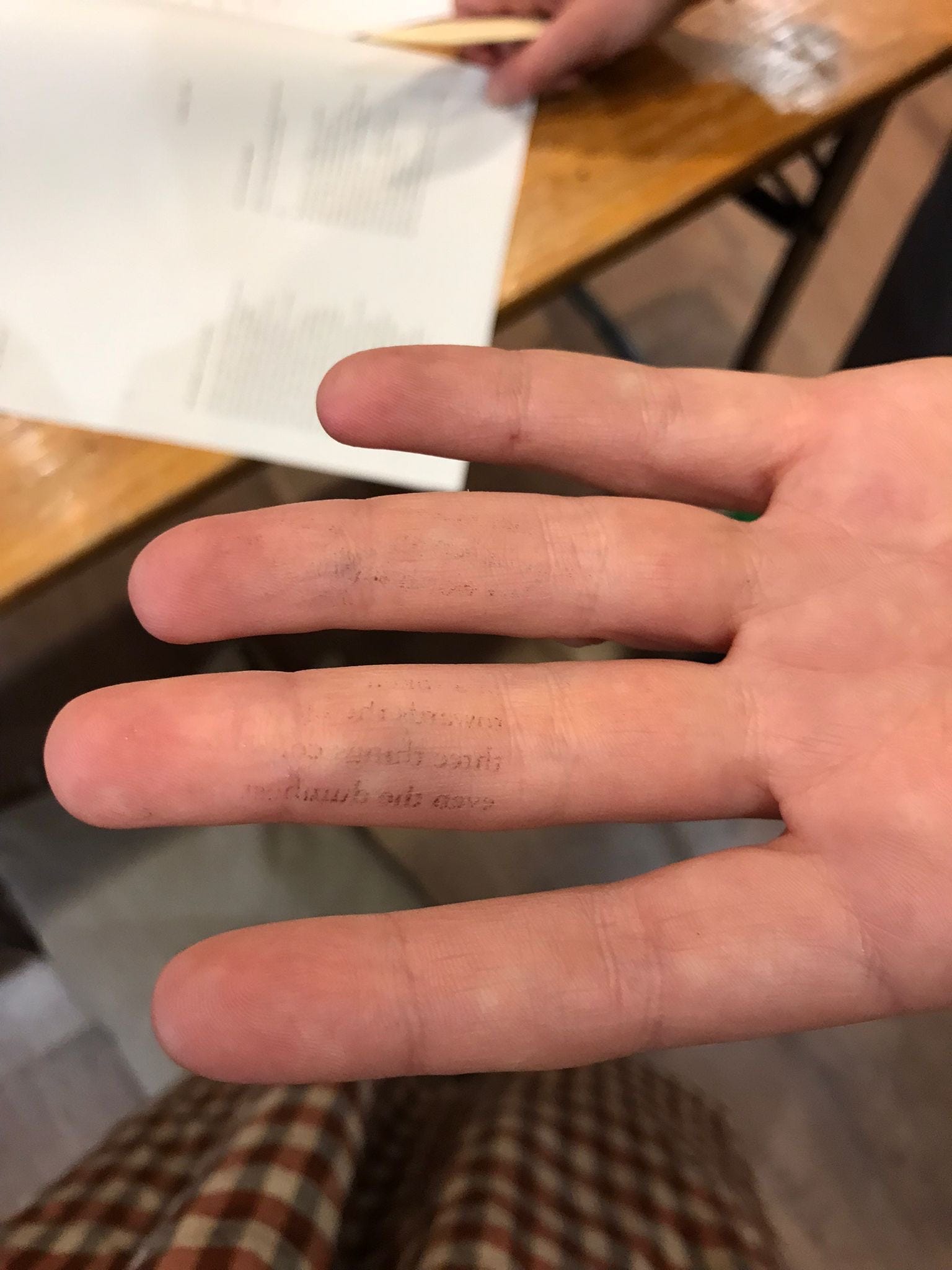
It was fascinating, frustrating and absorbing work. The poems, as they were printed and cut and assembled, flickered between, on the one hand, arrangements of ink on a page that have to be carefully aligned, and, on the other, language itself, with individual lines catching my eye as I ordered the sheets for stapling: ‘Down the cheeks of infancy… Abhorrent, man’, ‘Back in the day we had static’, ‘Orpheus’s stuff still bangs’. (Or ink on a finger – this from ‘My Apes’:)
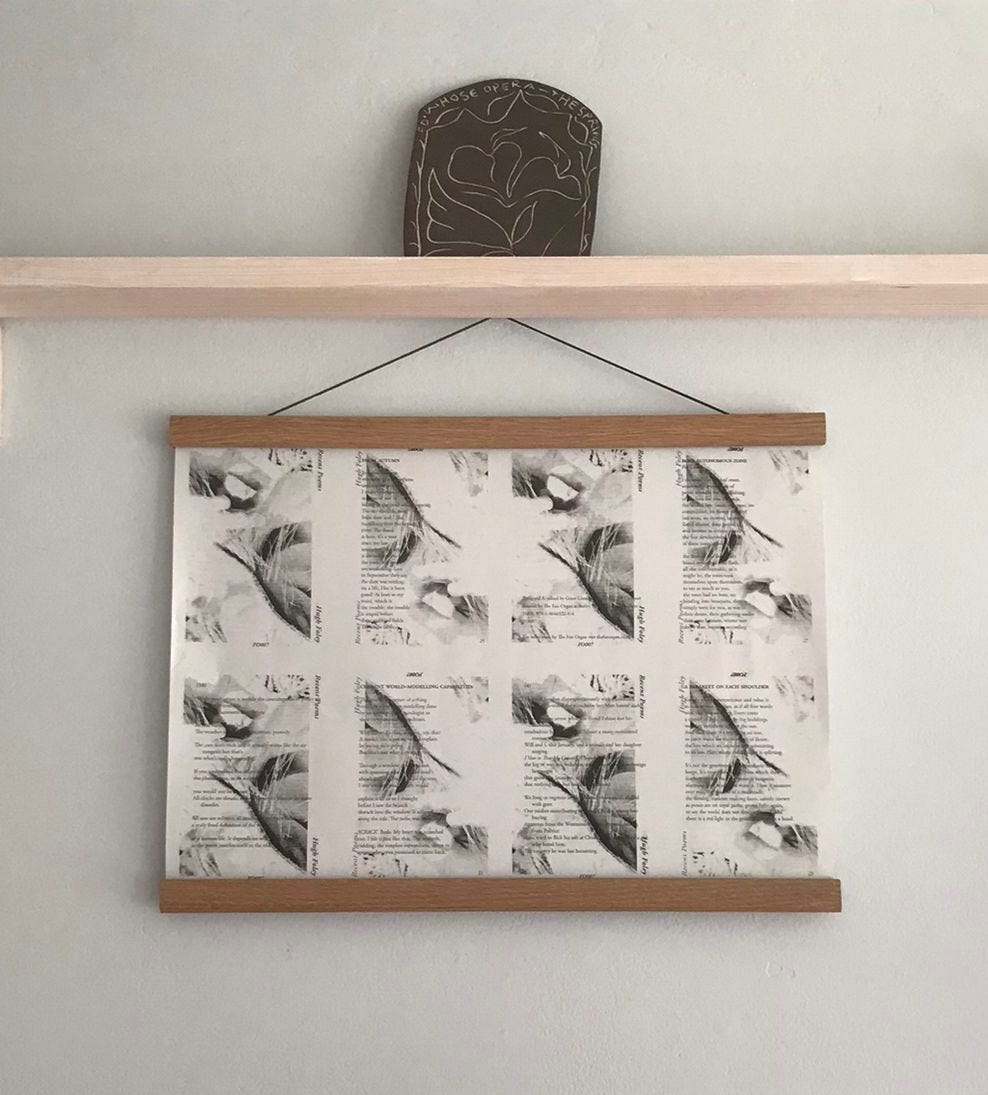
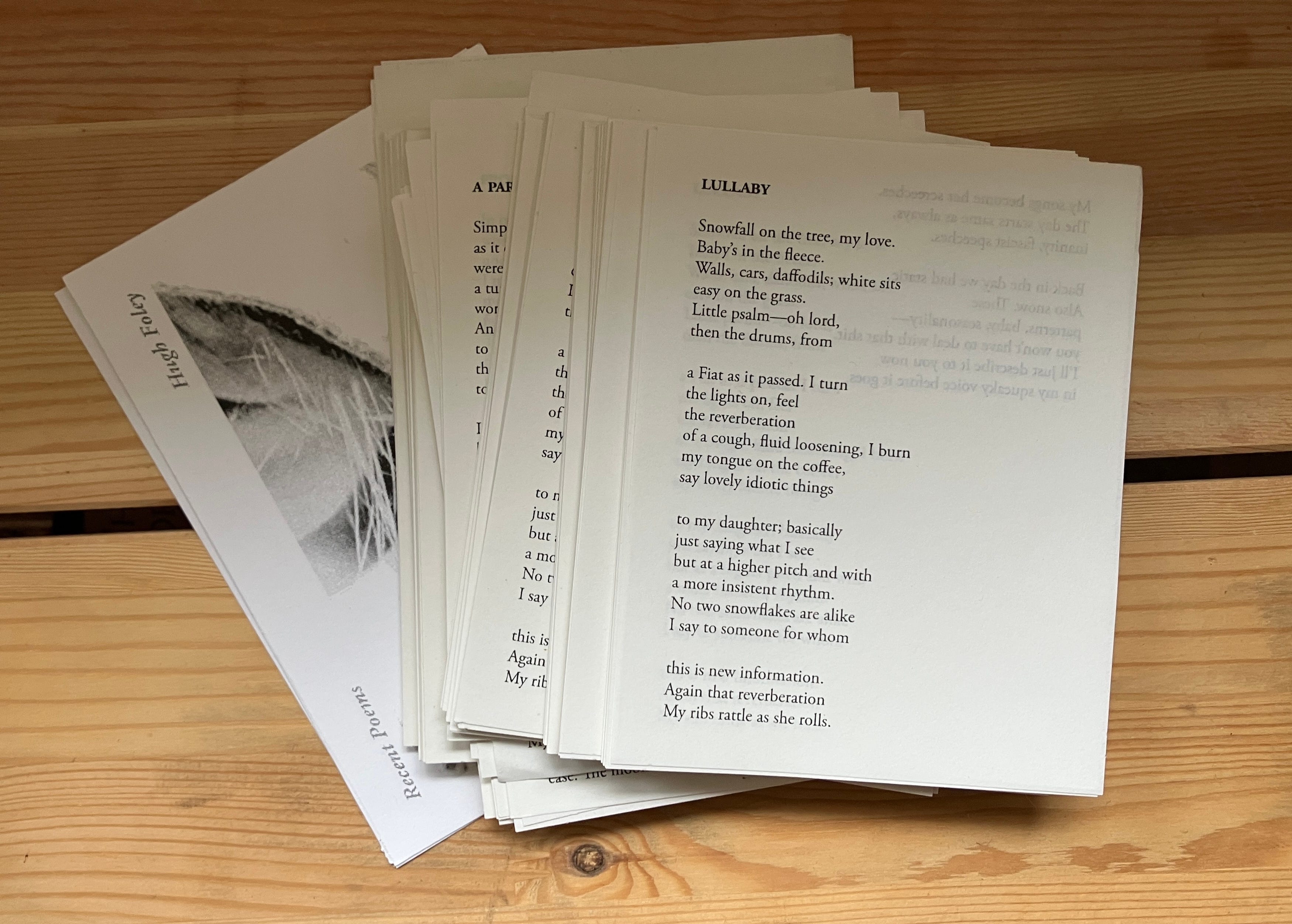
I was also struck by the kind of anxiety and disgust that accompanies things that you have made yourself, something that having an external printer somehow does away with. Certainly I felt more critical about these pamphlets, more aware of variation between the copies and of the way that with riso there are always quirks of alignment. Lifting the printed A3 sheets to the light to check if recto and verso were in the same place, you could see the way that, where page numbers in one part of the sheet were perfectly aligned, at the edges they would be one or two millimetres out – which with an A6 pamphlet is quite a lot, but is a feature of the medium. And as Grace said at the end, it was striking to find out quite how many ways you could go wrong, how many opportunities there were for making mistakes. I found it surprisingly tiring, with every stage requiring a concentration that was both mental and physical; both fingers and mind could slip and give you a double cover, or trim too much, or miss a sheet that the Risograph had skipped and left unprinted. Mistakes and trials became objects in their own right, like this which Grace claimed for herself, and these single sheet poems and covers which I intend to distribute somehow and somewhere:
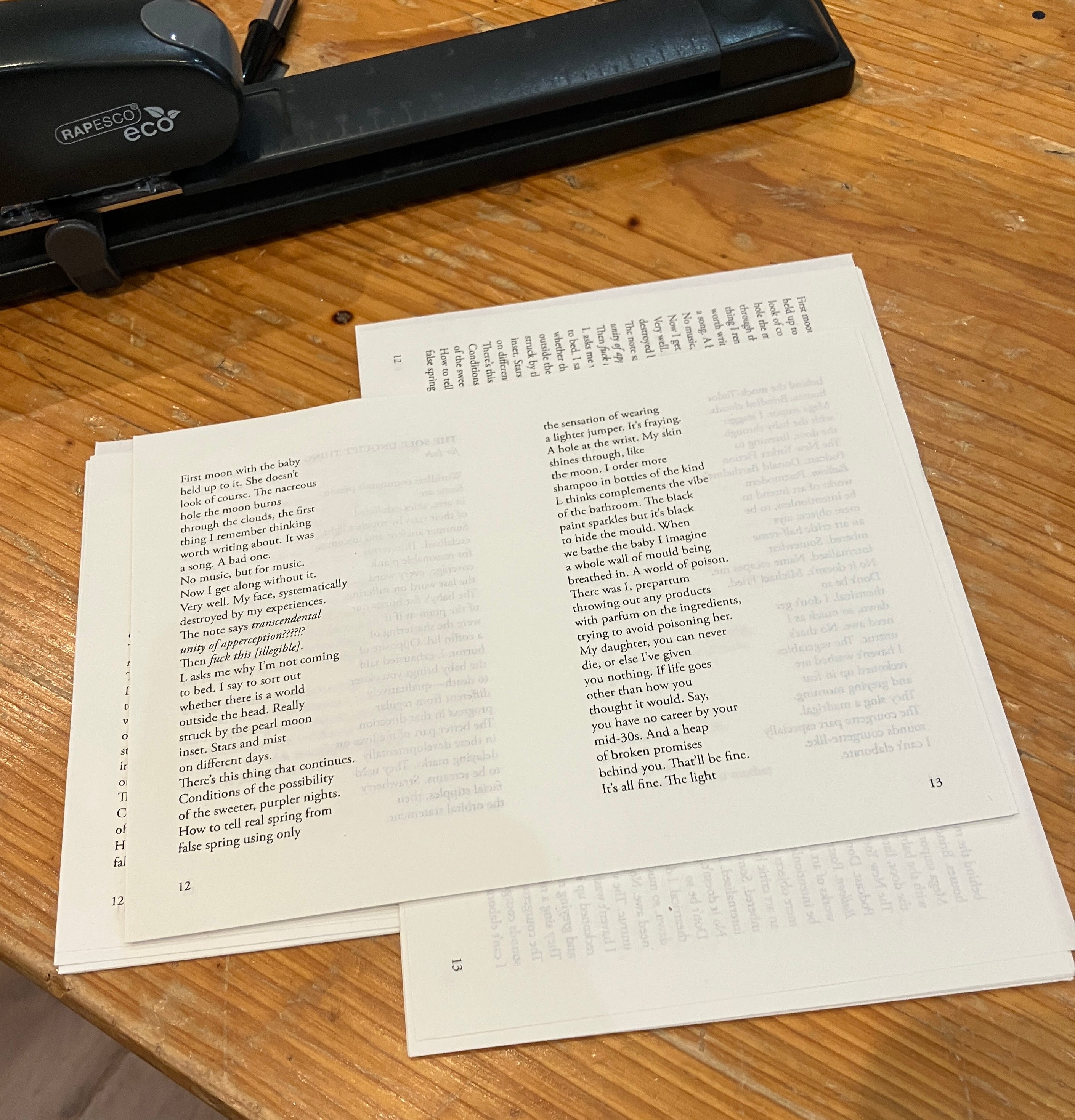
Maybe one of the biggest downsides of doing your own printing is not being able to admire and praise someone else’s work; I love receiving pamphlets from the printer, seeing how someone else’s technical skill has turned a pdf into an object, made of an idea something beautiful. Here, I suppose, I can instead praise and admire the training Emma gave us, and how good it is to work with Grace – and, of course, Hugh’s poems. Here is an excerpt from the longer poem, ‘The Sole Unquiet Thing’, at the centre of the pamphlet:
And here is a link to buy it, in advance of the awards ceremony on the 9th June:
https://lindentree.bigcartel.com/product/recent-poems-by-hugh-foley