
Wind the Bobbin Up
launching a pamphlet, nursery rhymes, lace-making, children's games
Sunday was the launch of a pamphlet from a project I’ve been leading with Edwina Attlee, responding to the nursery rhyme and singing game ‘Wind the Bobbin Up’. To introduce the launch, I said something like this:
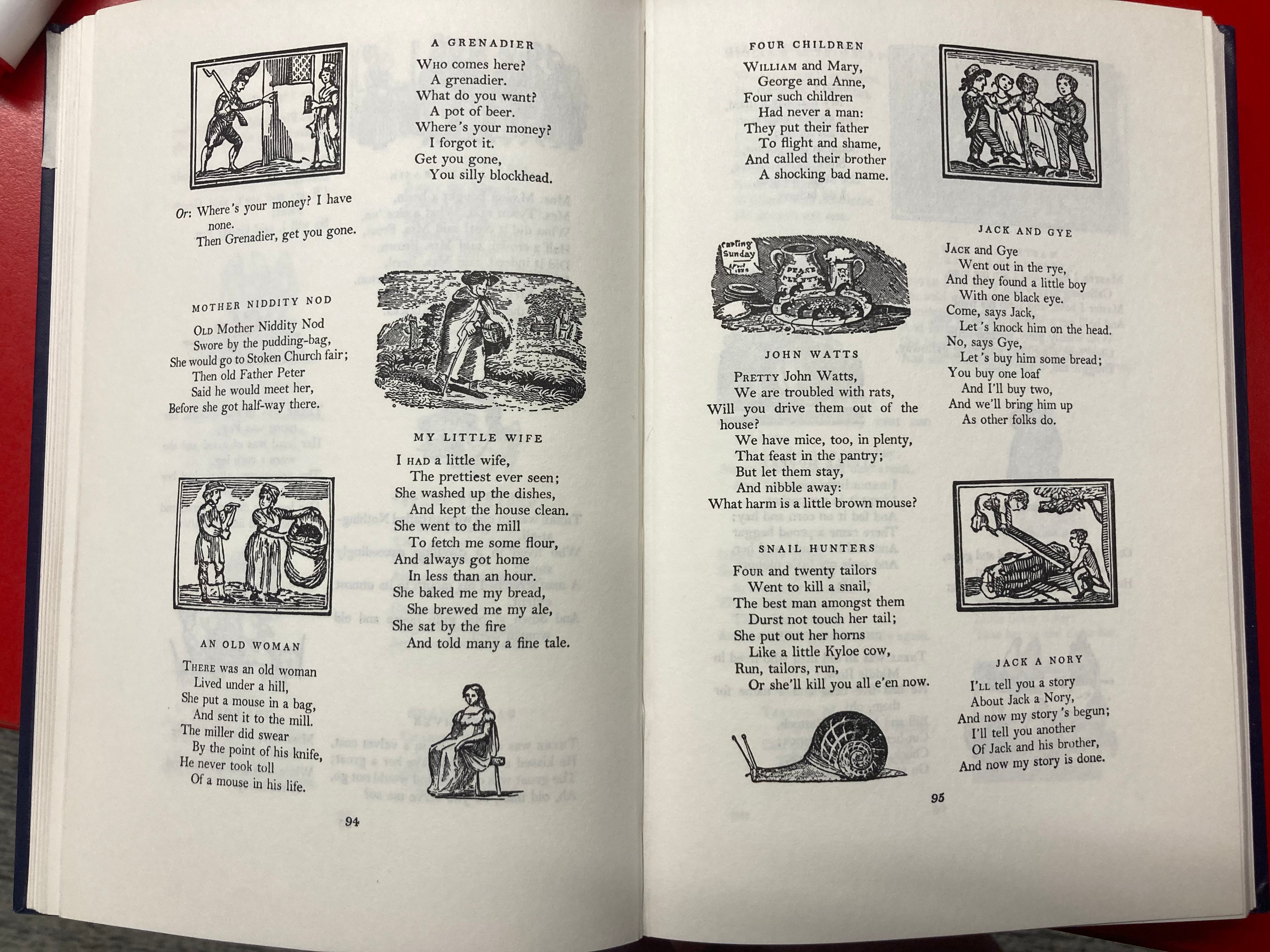
I came to nursery rhymes through Peter and Iona Opie’s Oxford Nursery Rhyme Book (1955). I was consulting it for a translation, which it didn’t, in the end, help with, but as I read through I was struck by the violence and the sexuality of the rhymes. And also the oddness – the confidence of the strange logic which is asserted so simply and plainly that it appears to speak to a more basic or profound truth, a reality more real than ours.
I was reading Robyn Skyrme’s Candles and Water and, in a piece about Sean Bonney, found this expressed there as an appreciation of Bonney’s poem ‘ACAB: A Nursery Rhyme’:
‘for “I love you” say fuck the police’ is ‘up above the world so high’: the playground injunction of the annihilation of these murderers is precisely the truth of injustice interacting with the overriding truth of a better universe, it is the truth of the cow jumping over the moon, it makes the exact same sense, and somewhere in language, there are schoolkids maintaining that truth.1
So I had been thinking about the nursery rhyme as a poetics, a model for the kind of poetry I wanted to be writing, and also the nursery rhyme as a form with political potential, when Edwina proposed the project. My task for this introduction [I was following Edwina, who had spoken about Wind the Bobbin Up as a work song] is to speak about our process, and one of the very first things we did was to have a go at writing our own nursery rhymes, which is harder than it might look. We did this exquisite corpse-style, each person writing a line and then folding it over, although in fact the previous line had to be visible for the rhyme and metre, so it was only the previous-but-one that was hidden. Here are some of our attempts:
O rise, daughter, stand on your feet
Butcher, butcher, where is your meat?
You’ll never be up if you’re not around
You’ll never get wet if you don’t make a sound.
Eewi keewu beenu wee
Trankl slooshl chipping cree
What do the birds say?
This is what the birds say
Eewi keewu beenu wee.
We have met, in person and online, over several months to share ideas, things we have been reading, images, our work in progress, preoccupations, bobbins and bobbin-like things, some of which we have brought today – Hannah Machover, for instance, has brought lace bobbins which she had painted, and Charlotte Geater lace bobbins which she has spangled, also the starting point of her poem for the pamphlet. Those ideas have also included John Wayne Bobbitt, whose penis was cut off in the late 1980s – this was Mark Waldron – and the French children’s song, ‘Ah ! vous dirai-je maman’, whose tune is used in Twinkle twinkle, Baa baa black sheep, etc., which Hugh Foley brought along. Hugh can’t be here today but I’ve mounted the song on a cardboard bobbin:
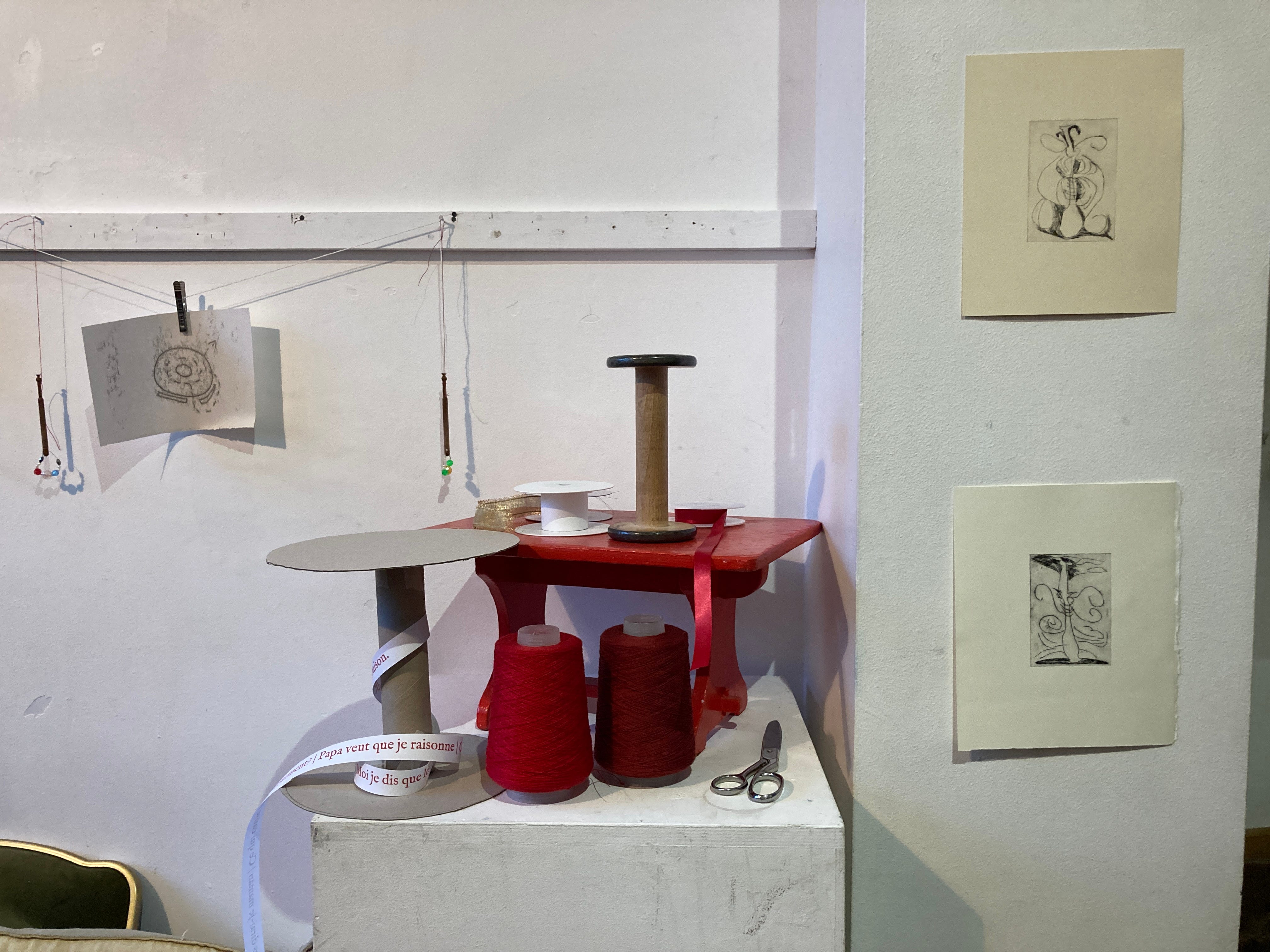
We all also each drew our own bobbins, which are scattered anonymously throughout the pamphlet – a bit like a primary school tea towel, someone said, and so we have also made a tea towel with the bobbin drawings on, which haven’t yet arrived, but which are available to pre-order for Christmas here.
So throughout, we have been working with a common source, but also working with and building on each other, and bringing in other sources – not to be too neat about it, but thinking, perhaps, of the bobbin as a structure on which various stuff can be wound and re-wound, a form that can hold whatever it is that needs to be kept in one place to be used in creating something else, that keeps things in order for a while and stops them getting tangled.
With this last part, I was thinking in particular of my own poems for the pamphlet, one of which tried to work through (‘untangle’) something of what I wrote about last time. At the launch I didn’t read that one, but the other poem, more celebratory, which is about my friend’s daughter at 3 months, and a second, seasonal, poem, not in the pamphlet, that I’ve included below.
Sitting in a circle with the audience we read from our seats (in an order that was more lace-like than the circular movement of a wound bobbin, and for that reason perhaps a bit over-complicated): Charlotte Geater read part of ‘Spangling My Bobbins’ and another poem based on nonsense, Mark Waldron read – from memory – his poem ‘Clap Clap Clap’, Emilia Weber read her villanelle ‘We All Fall Down’ and later a poem by Holly Pester, Grace Connolly Linden read her poem ‘fiat experimentum in corpore vili’, Aisha Farr read her poem which is part-image, based on the similarity between bobbins and the letter I, Edwina read a new poem and her nursery rhymes from the pamphlet (which demonstrate that it is possible to write your own!); we played a recording of Angela Shackel reading her poem ‘Open, Shut Them’ with the help of her son Orlo, Nicola Thomas read parts of her poem, ‘One Finger One Thumb’, about the constant motion of early parenthood and the mechanisation of baby-rocking, Hannah Machover read a torchon (a form of sestina, whose name comes from a form of lace-making) and Frith Taylor read her untitled poem from the pamphlet that draws on Comenius’s Orbis Sensualium Pictus, in which children learn to speak correctly through imitating animal (and other) sounds. There are also poems in the pamphlet by Hugh Foley and Vicky Sparrow, who couldn’t be there to read them.
We then invited everyone to share their own nursery rhymes and songs and prompts, which included a rude version of ‘Oh dear, what can the matter be?’ (‘First one in was fat lady Humphreys / Squeezed herself down and she said it’s quite comfy / But when she was through she could not get her bum free’) and a lace-telling song from a radio ballad by Jackie Oates. I used it as an opportunity to read a rhyme that one of the children interviewed by Iona Opie recites, from this Radio 3 programme:
tell tale tit
your tongue will split
and all the little birds
will have a little bit
If it had not been a bit indecent to take up too much time as one of the organisers, I would also have talked about how in that programme a child describes a game called ‘Spotlight’ in what seemed to me an extremely pregnant way:
you just get out of the light: you go from one dark place to the next dark place; you can play Spotlight all on your own.
and possibly also about how last summer I went for a long walk and the whole week I couldn’t stop hearing in my head the playground song, ‘What do you do if you need a poo / In an English country garden?’ As I passed through the room after the readings, I overheard people talking about different names for the game ‘tag/tig/it’ – which in Nottingham was always called ‘dobby’.
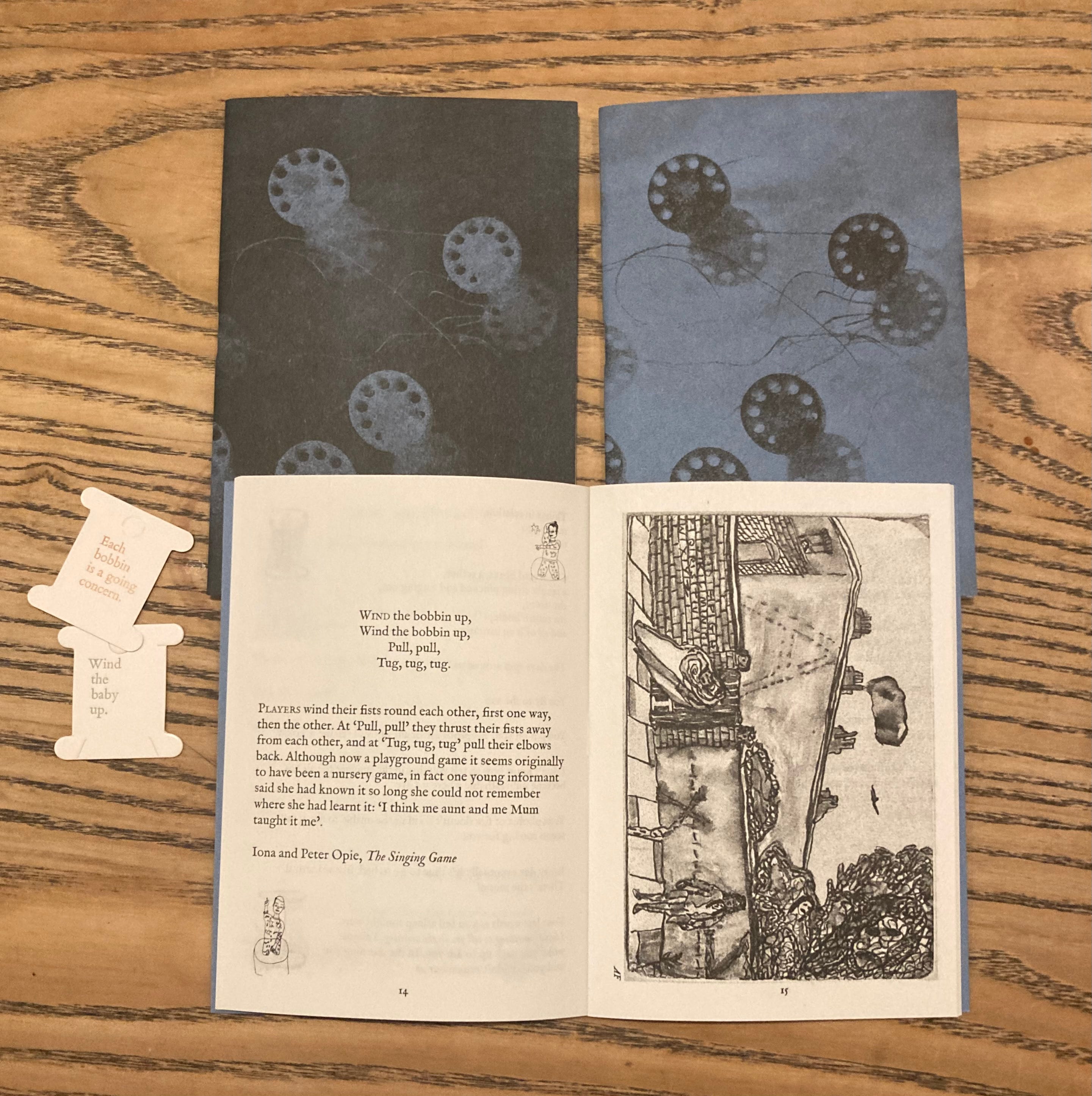
The pamphlet was printed by earthbound press and comes with a letterpress bookmark printed by Nicola Thomas. It is available here.
For P.E., Advent 2024
what to my mouth
is a mince pie
after our half-natural
morning; and what
is this bright sun
after the dark situation?
yes: bright sun
after the dark situation
I have written about Skyrme and nursery rhymes for Dummy magazine, which should be coming out soon.